
Roots in the 1860s, eyes on the future
Diak has been providing education in social services, health care and church community work since 1996 as well as interpreting programmes since 1997.
However, diaconal work and the birth of Diak as an institution extend much further back in time. Did you know that Helsinki Deaconess Institute, one of the organisations behind Diak, began training deaconesses as far back as 1867?
In the following decades, schools administered by diaconal organisations were established across the country. Diak’s origin is rooted in these institutes.
The history of universities of applied sciences
In the 1980s, Finland had so many young people coming through upper secondary education and vocational education that there was a shortage of places in higher education. In addition, the country had a severe labour shortage at the end of the decade.
People wanted to enter higher education, but many couldn’t get a university place and consequently weren’t able to find employment.
In 1989, discussions began on the establishment of workplace-oriented, practice-focused vocational higher education alongside traditional university education which focused on theory.
The proposal initially faced a lot of resistance, but in 1991 the Finnish government granted the first trial licenses for what were then known as polytechnics.
It established the so-called dual model, in which scientifically focused universities and workplace-focused polytechnics operated side by side but with two distinct approaches.
The purpose of the polytechnic system was to remedy the problems encountered in the previous system, develop the quality of education and respond to changes in society and the world of work.
Establishment of a diaconal polytechnic
The education reform also led to an idea for a diaconal higher education institution. It was feared that the quality of church community work and youth work could suffer if qualifications for the sector were left as vocational secondary education qualifications.
Another aim was to ensure the eligibility of the qualifications both for church community roles and those in the wider public sector.
In summer 1993, a proposal was submitted to the government on a polytechnic that would offer broad-based vocational education in health and social care and church community work and youth work.
However, the government had decided to not offer further trial licences for new polytechnics. The view was that a polytechnic with a focus on social and church community work did not warrant a higher education status, and society had no need for a Christian higher education institution founded on “human relations education”.
As a result of the 1995 reform of the polytechnics legislation, polytechnics had to establish a separate body that was responsible for the institution’s administration – this could be a municipality organisation, foundation or limited company.
The idea for a diaconal polytechnic was revived. The Diaconia University of Applied Sciences Ltd was established in 1995 by Helsinki Deaconess Institute, Pori Deaconate Institute and the Church Training College Foundation.
Carity in purpose and focus
In the trial stage, several other operators were brought on board to ensure broad-based ownership. The trial operation of Diak began in August 1996.
The Foundation of Turku Christian Institute, which trained sign language interpreters and media graduates, came on board the following year. Suomen Sisälähetysseura (later Kirkkopalvelut) signed a shareholders’ agreement in 1996 and already in the next year the unit in Pieksämäki started operating.
Diak was granted permanent UAS status in autumn 2000, and Oulu Deaconess Institute and Lahti Deacony Foundation joined at the same time. Diak initially had multiple branches, and its diverse background organisation meant having a network-based approach from the very beginning.
From 2007 the Evangelical Lutheran Church of Finland has been one of the owners of Diak. Other owners are ecclesiastical diaconal- and educational foundations. However, Diak doesn’t consider religious conviction as basis of recruitment.
The organisation was ultimately too fragmented, and a more joined-up organisation was created during the first decade of the 21st century by merging branches into units in the south, north, east and west of the country. The campuses of the Helsinki metropolitan area were merged in 2011 and relocated in 2016 to the new campus in Kyläsaari.
Focus on the future
Today, Diak has a well-established place in the Finnish and international higher education field.
We are the largest higher education provider in the social services sector with approximately 3,400 students in our programmes.
Diak educates a diverse range of experts for church community work and social service roles. Our wide range of services and RDI activities enable us to engage in active dialogue with broader society and help us innovate solutions to current and future challenges.
Diak will continue to develop through interaction with society and the higher education field in line with its values and goals.
Source: Ihmisen arvo – Helsingin Diakonissalaitos 150 vuotta (ed. Jyrki Paaskoski, 2017) and Diakin synty ja kehitys yksityiseksi kirkolliseksi ammattikorkeakouluksi (Mikko Malkavaara ja Raili Gothóni) in Muutosvoimaa – tutkielmia Diakista ja teologiasta, Diak puheenvuoro 3, (toim. Raili Gothóni, Mikko Malkavaara & Minna Valtonen, julk. 2016)
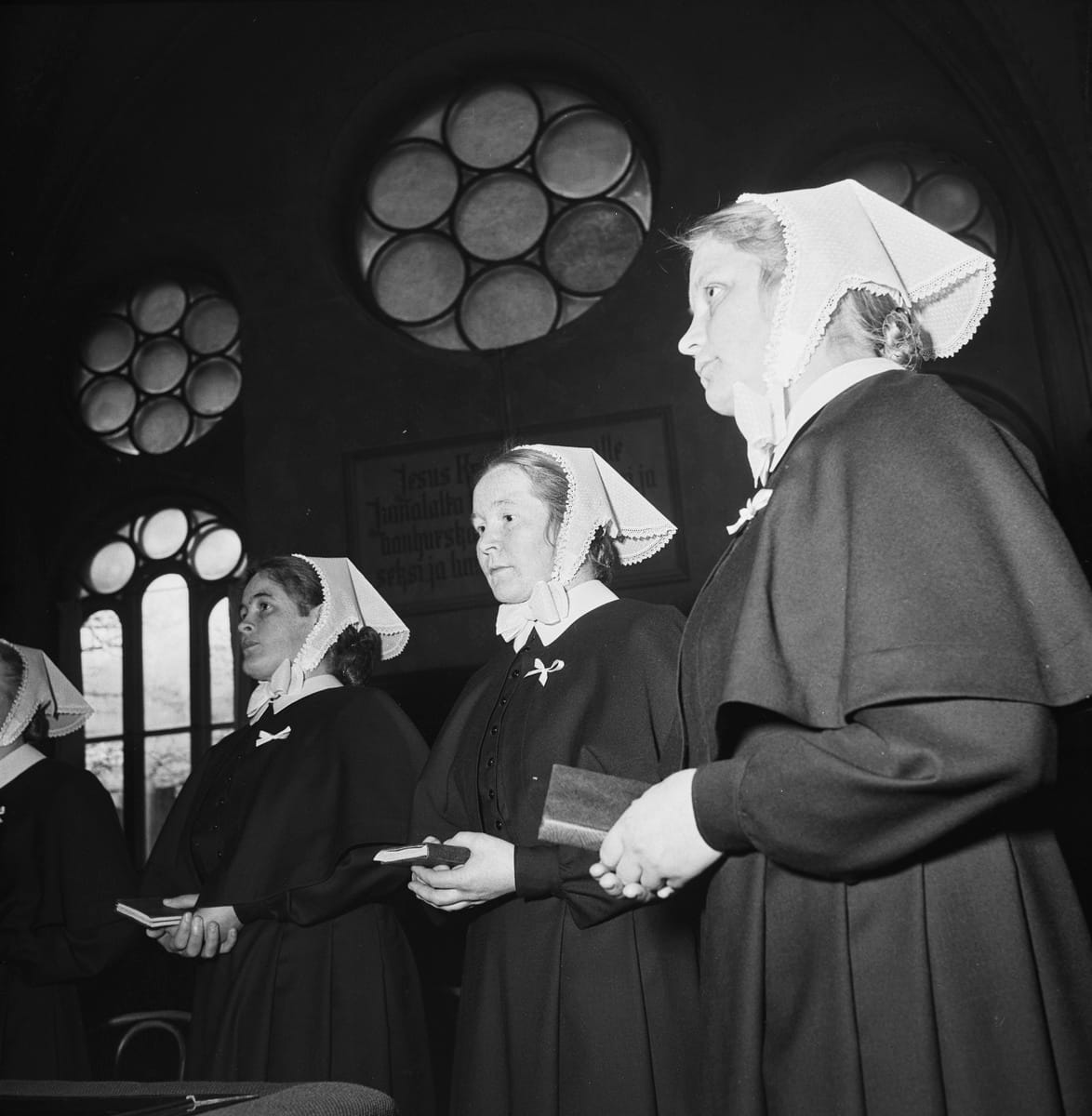
Photograph: Consecration of deaconesses at the Deaconess Institute Church in Helsinki in 1954. Photographer: Pekka Kyytinen. Folklore Collection, Finnish Heritage Agency.